Venus is the principle of attraction.
It is the place in us that recognizes beauty, seeks harmony, and moves toward what feels nourishing, meaningful, or alive. Astrologically, Venus describes how we relate – not only to others, but to pleasure, value, worth, and the experience of being drawn toward life itself.
Where Mercury asks How do I understand?, Venus asks What do I love? What do I desire? What do I find beautiful, comforting, or worthy of devotion?
Venus governs the subtle currents of preference and aversion that shape our choices long before they become conscious decisions. It influences how we give and receive affection, how we experience intimacy, how we engage with beauty, art, and pleasure, and how we assign value – to people, experiences, money, and ourselves.
On an inner level, Venus reveals our relationship with receiving. How open we are to softness, enjoyment, rest, and connection. It reflects the ways we allow life to meet us, and the conditions we believe must be met in order to feel worthy of love or abundance.
Ruling both Taurus and Libra, Venus is not loud or forceful. Her power lies in magnetism rather than pursuit. In the quiet pull toward what resonates. In the body’s yes. In the heart’s recognition.
To live consciously with Venus is to attune to the intelligence of attraction; to understand what you are drawn toward, why you are drawn there, and how those desires are shaping your inner and outer world. Venus teaches that value is not earned through striving, but revealed through presence, alignment, and the willingness to receive.
Venus Symbol & Archetype
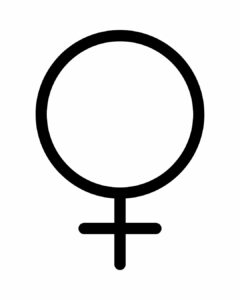
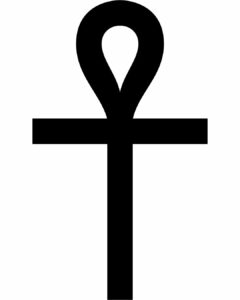
Pictured: 1 – Venus Glyph. 2 – Ankh Symbol.
Venus’ glyph is a symbol of embodied harmony.
At its core is the circle; consciousness, wholeness, the soul aware of itself. This is the receptive field of being, the place of presence where experience is felt rather than analyzed. Venus begins in awareness, not action.
Beneath the circle rests the cross, grounding consciousness into matter. Where Mercury’s cross speaks to lived experience as information, Venus’ cross speaks to incarnation. The soul entering the body. Spirit choosing form. Desire taking shape through sensation, relationship, and value.
Read together, the Venus glyph tells a simple yet profound story: consciousness embodied. Love made tangible. Beauty lived rather than imagined.
Esoterically, the symbol is often linked to the ankh (image 2), the ancient sign of life. Here, Venus becomes the life force that animates form with meaning and pleasure. It is not merely attraction, but the pulse that draws soul into matter again and again.
As an archetype, Venus is the Magnet, the Harmoniser, the Relational Field. She does not chase or convince. She invites. She softens. She creates coherence through resonance rather than force. Venus teaches through experience of pleasure and discomfort alike, revealing what aligns with our values and what does not.
Energetically, Venus moves through the body before the mind. Through sensation, emotion, taste, touch, aesthetics, and relational chemistry. She speaks in preferences, longings, and subtle yeses and noes.
To live in relationship with Venus is to listen to what draws you closer to life. To notice where you open, where you withdraw, and what those movements reveal about your inner values. Venus reminds us that love, beauty, and worth are not abstract ideals – they are felt realities, guiding us toward harmony through embodiment.
Venus Mythology & Story
In classical mythology, Venus is known as Aphrodite: the goddess of love, beauty, pleasure, and attraction. Her most famous origin story tells of her birth from the sea, rising fully formed from the waters. This myth matters astrologically because Aphrodite does not emerge through lineage or hierarchy, but through creation itself. Love is not earned. It arises.
Aphrodite’s power is not moral, strategic, or orderly. It is magnetic. She disrupts systems through desire, softens defenses through pleasure, and rearranges priorities simply by being present. Gods and mortals alike are altered in her wake, not because she demands change, but because attraction reshapes choice.
In Roman myth, Venus becomes more entwined with fertility, prosperity, and social cohesion, revealing another layer of her archetype: love as a binding force within culture, lineage, and continuity. Beauty here is not indulgent, but sustaining. It keeps life turning toward itself.
Across esoteric traditions, Venus carries the frequency of coherence: the principle that draws disparate elements into harmony. She does not resolve tension by force, but by resonance. By reminding the body and heart of what feels aligned.
Astrologically, these myths show us how Venus behaves. She moves through invitation rather than pursuit. She teaches through pleasure and pain alike. She reveals truth through attraction and aversion, showing us where our values are alive – and where they are compromised.
Venus reminds us that love is not passive. It is an active intelligence shaping the world through what we choose to move toward.
Venus Key Words & Themes
- Venus keywords include:
- Attraction & magnetism
- Love & affection
- Pleasure & enjoyment
- Beauty & aesthetics
- Values & worth
- Relationship & relating
- Harmony & balance
- Desire
- Receptivity & receiving
- Sensuality & embodiment
- Taste, preference & choice
- Money, resources & exchange
- Self-worth & self-value
- Intimacy
- Coherence & alignment
- Creative fertility & artistry
- Consent, boundaries & mutuality
Venus Psychological Expression
Psychologically, Venus describes the felt experience of relating. How we experience closeness, pleasure, and value in both ourselves and our relationships. It governs the inner landscape of desire – what feels nourishing, what feels safe to receive, and what we move toward instinctively.
At an inner level, Venus reflects our relationship with self-worth. The quiet beliefs we hold about what we deserve, how lovable we are, and whether it is safe to soften, enjoy, and be met by life. These beliefs often form early, shaped by attachment patterns, relational experiences, and the ways love, affection, and approval were modeled or withheld.
Conditioning around Venus can show up as people-pleasing, over-giving, avoidance of conflict, or a reliance on external validation to feel valued. Pleasure may feel conditional, earned, or tinged with guilt. Desire may be suppressed, exaggerated, or projected onto others rather than owned internally.
In its shadow expression, the psychology of Venus can represent a loss of clarity around boundaries. Attraction may override discernment. Harmony may be maintained at the cost of authenticity. Relationships may become places where worth is negotiated rather than embodied. Conversely, Venus can contract into withholding – difficulty receiving, fear of dependence, or emotional distance masked as independence.
In healthy expression, the role of Venus is grounded and self-referencing. Worth is not outsourced. Pleasure is welcomed without apology. Relationships become spaces of mutuality rather than compensation. Desire becomes informative rather than controlling, guiding us toward what aligns rather than what distracts.
Psychological maturity with Venus is not about perfect relationships, but about honest relating. Learning to listen to attraction without losing oneself, to receive without obligation, and to let pleasure be a teacher rather than a reward. Venus invites us into intimacy with life itself, beginning within.
Venus Spiritual & Mystical Meaning
On a spiritual level, Venus is the intelligence of coherence.
It is the principle through which soul recognises itself in form. The subtle force that draws life toward harmony, union, and remembrance through love, beauty, and attraction. Venus teaches that the sacred does not exist apart from the world, but within it – felt through the body, the heart, and the quiet yes of alignment.
Esoterically, Venus is linked to the pentagram cycle, tracing a five-petaled rose across the zodiac over eight years. This pattern reveals Venus as a teacher of rhythm and devotion – love returning again and again, refining itself through experience. In this way, Venus is initiatory. Each attraction carries a lesson. Each desire holds a remembering.
Venus invites the soul to soften into embodiment. To allow pleasure to be a portal rather than a distraction. To experience love not as attachment, but as resonance with what is true and alive. Through Venus, the body becomes a temple. Sensation becomes prayer. Beauty becomes a form of gnosis.
In many mystical traditions, Venus is associated with the sacred feminine – not as gender, but as receptive creative force. The capacity to receive, gestate, harmonise, and bring spirit into form through devotion rather than effort.
In its transcendent expression, Venus reveals love as a unifying field. A frequency that dissolves separation without erasing difference. This is Venus beyond romance – the soul’s memory of belonging within the living web of life.
To walk with Venus consciously is to trust attraction as guidance, and to allow beauty to lead you back into communion with the sacred made visible.
Venus Challenges & Growth Edges
Venus’ challenges arise where love becomes conditional.
This planet highlights wounds around worth, belonging, and receiving. Early experiences where affection was inconsistent, approval was earned, or harmony depended on self-suppression can shape how Venus learns to relate. Over time, love may become something to manage rather than inhabit.
A central growth edge for Venus is confusing harmony with self-abandonment. The desire to keep peace can override truth. Needs may be softened, delayed, or unspoken to preserve connection. Pleasure may be negotiated rather than trusted. In these patterns, Venus learns to adapt instead of to resonate.
Another challenge lies in externalising value. Seeking worth through relationships, beauty, productivity, or material stability can disconnect Venus from her inner reference point. Attraction may pull us toward what confirms our value rather than what truly nourishes us. Conversely, Venus may withhold – resisting intimacy, pleasure, or dependence as a form of self-protection.
Venus also carries resistance around receiving. Allowing care, generosity, or love to land can feel vulnerable, undeserved, or destabilising. In these moments, independence masks a fear of being seen or met.
Growth with Venus begins by restoring an internal sense of worth. Learning to feel value as inherent rather than negotiated. Allowing desire to be information rather than obligation. Practicing boundaries that protect connection rather than sever it.
The medicine of Venus is not perfection in love, but presence. When self-worth is embodied, attraction clarifies, pleasure deepens, and relationships become places of resonance rather than repair.
Venus Astrology in the Birth Chart
In the birth chart, the placement of Venus reveals how you love, what you value, and how you experience worth. It describes the inner compass that guides attraction – the subtle intelligence that draws you toward people, experiences, and environments that feel harmonious or meaningful.
Venus in the zodiac signs reflects the style of love and relating. The tone through which affection is expressed, pleasure is sought, and value is perceived. Some signs orient Venus toward immediacy and passion, others toward stability, sensitivity, or reflection. This placement shows how love wants to move, what feels beautiful, and what creates a sense of ease and resonance.
Venus in the houses reveals where love, pleasure, and value are most alive. These are the life areas that invite connection, creativity, enjoyment, and exchange. Venus often highlights where we seek harmony, where we desire ease, and where we are learning to receive rather than strive.
Aspects to Venus add depth and complexity to how love and worth are experienced. They describe how Venus interacts with desire, emotion, structure, growth, and transcendence. Supportive aspects can indicate natural ease in relating or receiving, while challenging aspects often point to growth edges around boundaries, self-value, or attachment patterns.
Venus is shaped by the wider ecosystem of the chart. Its expression matures through relationship, experience, and conscious reflection.
Rather than defining how “good” we are at love, the position of Venus in the natal chart shows how love wants to be lived through us. When understood, Venus in your birth chart becomes a guide toward deeper alignment, authenticity, and embodied worth.
Venus placement through the signs, houses and aspects coming soon.
Planet Venus Transits & Timing
Venus transits describe the ebb and flow of attraction, relationship, and value.
As Venus moves through the zodiac, she shifts what we are drawn toward, what we find pleasurable, and how we seek harmony with life. Collectively, Venus transits influence cultural aesthetics, relational norms, economic themes, and the collective mood around love, beauty, and worth. Individually, they shape periods of connection, softening, re-evaluation, and relational reorientation.
Venus transits often bring subtle yet meaningful changes. We may feel pulled toward certain people, creative expressions, or experiences without fully knowing why. Preferences shift. Values refine. What once felt appealing may lose resonance, while something previously overlooked begins to call.
Each Venus transit carries both gift and shadow. In her clearer expressions, Venus opens pathways of ease, intimacy, pleasure, and appreciation. Relationships soften. Beauty becomes nourishing. We feel more at home within ourselves and our connections. In shadow expressions, attachment, comparison, over-compromise, or avoidance can arise. Desire may seek reassurance rather than alignment.
Venus’ retrograde cycle, occurring roughly every eighteen months, is a particularly potent period of initiation. During these times, the heart turns inward. Past relationships, patterns, or values resurface for review. What we desire, and why, comes into question. Venus retrograde is not about withholding love, but about refining it. Reclaiming worth from external sources and restoring it within.
Beyond retrogrades, Venus’ steady rhythm through the zodiac creates seasons of relational learning. Each sign invites a different expression of love, reminding us that attraction evolves as we do.
To work consciously with Venus’ timing is to listen to the heart’s changing language – and to trust that every shift in desire is guiding us toward deeper coherence.
Venus in Astrology: Planet of Love, Worth, Beauty & Harmony
To live consciously with Venus is to live in relationship with worth.
The role of Venus in Astrology is the practice of listening to attraction as information, allowing pleasure to guide rather than distract, and meeting yourself with the same tenderness you seek in others. Venus asks us to soften without self-abandonment, to receive without guilt, and to let beauty be a bridge back into presence.
When Venus is honoured, love becomes less about seeking and more about resonance. Desire clarifies. Relationships reflect truth rather than compensation. Worth is felt as something inherent, not negotiated.
Venus energy reminds us that harmony is not passive. It is a living, responsive intelligence, one that draws us toward what nourishes life, again and again.
Read next: Venus in the Zodiac, or Venus in the Houses.