
Mercury is where awareness begins to move.
It is the spark of perception that notices, names, and connects. The current that carries thought, language, curiosity, and meaning through inner and outer worlds. Mercury is not concerned with what is true in a cosmic sense, but with what is understood, exchanged, interpreted, and translated in the moment.
Astrologically, ruler of Gemini and Virgo, Mercury describes how consciousness travels. How we gather information and make sense of experience. How we speak, write, listen, learn, and share what we know. It is the bridge between inner awareness and the world beyond us, between self and other, Mercury the messenger that moves between realms, contexts, perspectives, and one another.
Where Mercury is present in our skies or in the astrological chart, life speeds up. Questions arise. Conversations unfold. Patterns are noticed. Connections are made. This planet governs the everyday magic of thinking, speaking, reading, remembering, asking, and responding. It is active in the small moments where meaning is formed long before it becomes belief.
On a deeper level, Mercury reveals the way we orient ourselves within reality. The mental habits we rely on. The stories we tell to navigate life. The lenses through which we perceive truth, difference, and possibility.
To live consciously with Mercury is to develop a relationship with your own mind. To learn how your awareness moves, where it gets curious, where it loops, where it sharpens, and where it needs space to breathe. Mercury invites presence in the act of thinking itself, reminding us that how we perceive is as powerful as what we perceive.

Mercury Symbol & Archetype
Like all astrological symbol, Mercury’s glyph is language in itself.
At its foundation is the cross: the realm of matter, lived experience, the physical world we move through day by day. This is where consciousness meets time, body, circumstance, and form. Mercury does not bypass this realm; it learns through it.
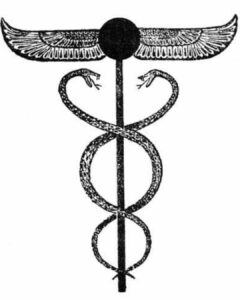
Rising from the cross is the circle, often depicted as a looping or enclosed form – consciousness observing itself. In some depictions of the Mercury Symbol (fig 2), as a serpent biting its own tail, an ouroboros, appears – symbolizing the self-referencing nature of the mind. Thought thinking itself. Awareness looping back to observe, interpret, and refine meaning through experience.
It also reflects the transformative essence of the mind itself – as Howard Sasportas said: “Mercury governs our thoughts and perceptions and these can limit us; but Mercury also gives us the ability to have new thoughts and perceptions which free or expand us; and to top it off, Mercury is that part of us capable of becoming aware that we can change our perceptions in this way.”
Crowning the symbol is the crescent – receptivity, curiosity, the capacity to receive and respond. Sometimes this crown is observed as wings – an evolved expression of the crescent. Here, receptivity becomes mobility. Curiosity gains lift. Awareness is no longer bound to one level of reality, but moves freely between planes. The wings represent Mercury’s capacity to travel between worlds: inner and outer, conscious and unconscious, human and divine.
Together, these elements show how Mercury operates: Meaning is born in lived experience. Reflected upon through awareness. Then carried, translated, and shared across thresholds.
This is the archetype of the Messenger, not as a passive courier, but as an active translator of reality. Mercury does not deliver fixed truths. It circulates insight. It loops experience into understanding, and understanding back into life.
Energetically, Mercury is adaptive, liminal, and quick to respond. It thrives in motion, dialogue, and exchange. When stagnant, it becomes restless or distorted. When alive, it becomes the sacred intelligence that allows consciousness to know itself through relationship.
To live Mercurially is to stay in motion with meaning – never frozen, never finished, always listening.
Mercury Mythology & Story
In classical mythology, Mercury is known as Hermes – the messenger of the gods, guide of souls, patron of language, travel, trade, thieves, and thresholds. From the moment of his birth, Hermes is depicted as quick, clever, and irreverent. He steals Apollo’s cattle on his first day of life, not out of malice, but curiosity and ingenuity, later resolving the conflict through wit, negotiation, and the invention of the lyre.
This story matters astrologically because Hermes does not operate by hierarchy or moral absolutism. He operates by movement, improvisation, and responsiveness. His intelligence is situational rather than fixed. He adapts to context, reading the terrain as he goes.
Hermes also holds the role of psychopomp – one who travels freely between worlds, guiding souls between life and death, conscious and unconscious, known and unknown. This capacity to cross boundaries without becoming trapped in them is central to Mercury’s function in astrology. Mercury is not loyal to one realm. It belongs to the in-between.
In Roman tradition, Mercury becomes associated with commerce, exchange, and negotiation; reinforcing the idea that meaning, value, and understanding are created through interaction rather than decree. In esoteric and alchemical traditions, Mercury is seen as the prima materia of consciousness itself – volatile, mutable, and necessary for transformation.
Astrologically, these myths show us how Mercury behaves: it learns through contrast, gathers meaning through dialogue, and evolves through motion. Mercury does not seek certainty. It seeks circulation. When communication stagnates, confusion and trickery arise. When movement is honored, insight flows.
To work with Mercury is to respect the sacred intelligence of the threshold – where meaning is always in motion.

Mercury Key Words & Themes
Mercury keywords include:
-
-
- Perception
- Awareness
- Cognition
- Thought & cognition
- Language & communication
- Curiosity
- Agility
- Connection
- Mental Habits & filters
- Learning & study
- Information exchange
- Connection through understanding
- Adaptability
- Sense-making
- Interpretation & meaning-making
- Mental agility
- Openness
- Listening
- Neutrality/Non-attachment
- Dialogue & conversation
- Translation (inner to outer, self to other)
- Movement between perspectives
- Pattern recognition
- Questions over answers
-
Mercury Psychological Expression
Psychologically, Mercury in the horoscope describes the felt experience of thinking. The inner voice. The way the mind moves when it is curious, anxious, inspired, overstimulated, or quiet. It governs how we orient ourselves to reality through thought, how quickly we process information, how we ask questions, and how we narrate our lives to ourselves.
At its core, Mercury shapes our mental habits. The patterns we default to when interpreting experience. Some minds move quickly and laterally, leaping between ideas. Others move methodically, building understanding step by step. Neither is inherently better, Mercury simply shows us how awareness travels.
Conditioning around Mercury often forms early. Through schooling, language, family dynamics, and cultural norms, we learn what kinds of thinking are rewarded, dismissed, or discouraged. Over time, this can solidify into rigid mental loops: overthinking, self-questioning, mental comparison, intellectualizing emotion, or filtering reality through inherited narratives rather than lived truth.
In its shadow expression, Mercury can become fragmented or defensive. The mind may race, fixate, distort, or disconnect from the body. Communication may turn reactive, overly analytical, evasive, or sharp. Information is gathered without integration. Words are used to protect rather than connect.
In healthy expression, Mercury is flexible and alive. Thought becomes a tool rather than a trap. Curiosity replaces assumption. Listening deepens understanding. The mind collaborates with intuition rather than competing with it. Communication feels responsive, clear, and adaptive – capable of nuance rather than certainty.
Psychological maturity with Mercury is not about controlling thought, but about relating to it consciously. Knowing when to engage the mind, when to question it, and when to let it rest. Mercury teaches that clarity is not forced, it emerges when awareness is allowed to move freely.

Mercury Spiritual & Mystical Meaning
On a spiritual level, Mercury is the initiator of consciousness into awareness.
It is the point where soul meets mind, where subtle knowing seeks form through language, symbol, and insight. Mercury governs the transmission of meaning from higher realms into lived experience, translating what is ineffable into something that can be perceived, named, and shared.
In esoteric traditions, Mercury is associated with Hermes Trismegistus, the legendary figure behind Hermetic philosophy. Here, Mercury is not merely a messenger, but a mediator between planes of reality. “As above, so below” is a Mercurial teaching – not as doctrine, but as a lived act of translation. What exists in subtle realms seeks expression through the mind, breath, voice, and written word.
Spiritually, Mercury invites us into right relationship with intelligence itself. Not intelligence as status or accumulation, but as responsiveness. As listening. As the capacity to receive guidance, insight, and symbolic information without distorting it through fear or egoic control.
The initiation Mercury offers is subtle yet profound: learning how to hear truth without immediately grasping it. How to let meaning arrive in its own timing. How to allow the mind to serve soul, rather than dominate it.
In its transcendent expression, Mercury becomes the sacred scribe. The channel through which wisdom moves into form. Words become vessels. Thoughts become prayers. Questions become doorways.
This is Mercury beyond noise and overthinking – the quiet intelligence that knows when to speak, when to listen, and when silence itself is the most accurate translation of truth.
Mercury Challenges & Growth Edges
Mercury’s challenges arise where the mind becomes disconnected from presence.
This planet highlights wounds around being heard, understood, or allowed to think freely. Early experiences where questions were dismissed, curiosity was corrected, or expression was met with criticism can create lasting imprints. Over time, the mind may learn to shrink, over-explain, perform intelligence, or stay perpetually on guard.
One of Mercury’s core growth edges is over-identification with thought. When the mind becomes the sole authority, it can loop endlessly, analyze without integration, or narrate life in ways that reinforce fear rather than understanding. Overthinking, self-doubt, comparison, and mental restlessness are common expressions of this imbalance.
Another challenge is miscommunication – not just with others, but internally. Assumptions replace listening. Stories replace direct experience. Words are used to defend rather than to connect. In these moments, Mercury becomes reactive rather than responsive, sharp rather than curious.
Resistance often shows up as mental rigidity. An unwillingness to revise perspective. A need to be right. Or conversely, a fear of speaking at all – withholding thoughts, insights, or questions out of concern for how they will be received.
Growth with Mercury begins by softening the relationship with the mind. Allowing thought to be a process, not a verdict. Learning to pause before reacting. To listen beneath words. To notice when thinking is serving understanding and when it is simply filling space.
The healing path of Mercury is not silence, but conscious dialogue – with self, with others, with life. When curiosity replaces defensiveness, and listening replaces assumption, Mercury becomes a guide rather than a gatekeeper.

Mercury Astrology in the Birth Chart
In the birth chart, Mercury reveals how consciousness moves through you. Not what you think, but how you think. How you gather information, process experience, speak, listen, learn, and make sense of the world around you. This is the lens through which reality is interpreted before it becomes belief or action.
Mercury in the signs describes the style of the mind. The tone, rhythm, and orientation of thinking and communication. Some zodiac signs incline Mercury toward speed and spontaneity, others toward reflection, sensitivity, or precision. This placement shows how curiosity expresses itself, what kinds of questions come naturally, and how meaning is most easily formed.
Mercury in the houses points to where mental energy is most alive. The life areas that stimulate thought, conversation, learning, and exchange. This placement often reveals where we are mentally preoccupied, where we speak most freely, and where we are constantly gathering data through lived experience.
Aspects to Mercury add nuance and complexity. They shape how easily thought flows, where tension or pressure exists, and how the mind integrates with emotion, desire, discipline, intuition, or vision. Supportive aspects can indicate ease of expression and adaptability, while challenging aspects often mark deep learning edges around communication, confidence, or mental overwhelm.
Importantly, Mercury is rarely static. It is shaped by its environment in the chart. Its expression is refined over time through experience, reflection, and conscious relationship with the mind.
Rather than defining intelligence, Mercury in the birth chart shows how intelligence wants to move through you. When understood and honored, it becomes one of the most empowering tools for self-awareness, connection, and growth.
Read about Mercury through the signs, houses and aspects.
Planet Mercury Transits & Timing
Mercury’s transits shape the tempo of life.
As the fastest-moving personal planet in our solar system, Mercury reflects the shifting currents of thought, conversation, information, and attention in both collective and individual experience. Its movement marks changes in mental focus – what we are thinking about, talking about, learning, questioning, and trying to understand in any given moment.
On a collective level, Mercury transits influence the tone of discourse, media cycles, education, trade, and communication systems. Themes emerge through language first – headlines, conversations, questions – before they take form elsewhere. Individually, Mercury transits activate periods of learning, decision-making, reflection, dialogue, and reorientation within the areas of life it touches.
Each Mercury transit carries both gift and shadow. In its clearer expressions, Mercury supports insight, connection, problem-solving, and adaptability. We notice patterns more easily. Conversations open doors. Curiosity leads somewhere meaningful. In its shadow phases, the same energy can feel scattered, rushed, mentally noisy, or reactive. Misunderstandings arise not because information is missing, but because listening is.
Mercury’s most well-known cycle is its retrograde rhythm, occurring three to four times a year. These periods of Mercury Retrogrades are not malfunctions, but entirely on purpose, and deeply medicinal, invitations inward. The mind turns reflective. Old conversations resurface. Information is revised. What was assumed asks to be re-examined. Retrogrades highlight where meaning was rushed or incomplete, offering the chance for re-translation rather than forward momentum.
Beyond retrogrades, Mercury’s ongoing cycle through the zodiac creates a steady rhythm of mental seasons – each asking us to perceive life through a slightly different lens. Working consciously with Mercury’s timing means respecting the mind’s need for both movement and pause.
Mercury teaches that clarity unfolds in cycles. When we listen to those rhythms, thought becomes an ally rather than a source of pressure.

The Astrological Mercury: Planet, Messenger, Psychopomp & More
To live consciously with Mercury is to be in relationship with your own awareness.
It is the practice of noticing how your mind moves, how meaning forms, how words shape experience. Mercury asks for presence in the act of thinking – not to control the mind, but to listen to it, question it, and allow it to remain fluid.
When Mercury is honored, communication becomes connective rather than performative. Curiosity replaces assumption. The mind becomes a bridge rather than a barrier. You learn when to speak, when to listen, and when to let understanding arrive without force.
Mercury reminds us that clarity is not something we grasp, it is something we cultivate through attentiveness, humility, and dialogue with life itself.
In this way, Mercury becomes less about information, and more about intimacy with perception.
Read more: Mercury through the Zodiac, Mercury in the Houses, Mercury in Aspect